China Isn't Catching Up to the US Anymore. On Most Fronts, It's Already Ahead.
Rare earths, solar, batteries, EVs, naval shipbuilding, AI enterprise adoption, biopharma patents, and now a Nobel laureate leaving Berkeley for Tsinghua — the list of fronts where China leads outright, not just competes, has gotten too long to explain away as isolated exceptions.
There's a version of the US-China competition still common in American commentary that treats China as a fast-improving challenger, closing gaps here and there but still fundamentally behind the United States on the technologies and industries that matter most. That version of the story is getting harder to defend one sector at a time, and taken together, the data across the fronts that actually determine long-run national power now describes something closer to the opposite picture.
Start with the physical inputs of the energy transition, because the numbers here aren't close. China controls roughly 90 percent of global rare-earth refining capacity and around 94 percent of sintered permanent magnet production — the specific components that go into everything from EV motors to precision-guided weapons. Its dominance in renewable manufacturing is even more lopsided in places: roughly 95 percent of global solar wafer production, about 85 percent of solar cells, and around 80 percent of both polysilicon and finished solar modules. In batteries, China holds close to 70 percent of global lithium cell production, 75 percent of cathode manufacturing, and 90 percent of graphite anode output. BYD has become the world's largest EV manufacturer outright. This isn't a country catching up on clean energy manufacturing. It's the country that already built the supply chain the rest of the world runs on.
The AI story is less absolute but arguably more consequential, because it's happening in real time and reshaping actual enterprise spending decisions. Chinese-origin AI models — Moonshot's Kimi K3, Alibaba's Qwen family, DeepSeek — hit a weekly peak of 46 percent of US enterprise AI token usage this year, up from just 4.5 percent in early 2025, driven overwhelmingly by a price gap running as high as 60 to 90 percent cheaper than comparable US models. That's not 90 percent of the global frontier AI market, and it's important not to overstate it — Claude Fable 5 and GPT-5.6 Sol still generally lead the broadest aggregate capability benchmarks. But a sustained, growing share approaching half of actual paid US enterprise workloads is a commercial fact with real teeth, not a benchmark bragging right, and the trend line over the past eighteen months points in only one direction.
Biopharma tells a similarly steep story. China's share of global biopharmaceutical R&D has grown from about 5 percent to nearly 20 percent since 2017, and Chinese biotech firms now account for close to 70 percent of global AI-driven drug discovery patent filings. China has become the world's second-largest source of new molecular entity launches, capturing an 18 percent global share, and out-licensing deal value from Chinese biopharma hit $56.7 billion in the first part of this year alone — a 132 percent jump from the same period last year. Pfizer's own CEO said publicly in March that US dominance in biotech "is being challenged by a competitor, and that's China," noting that eight of the top ten research institutions on the 2025 Nature Index are now Chinese.
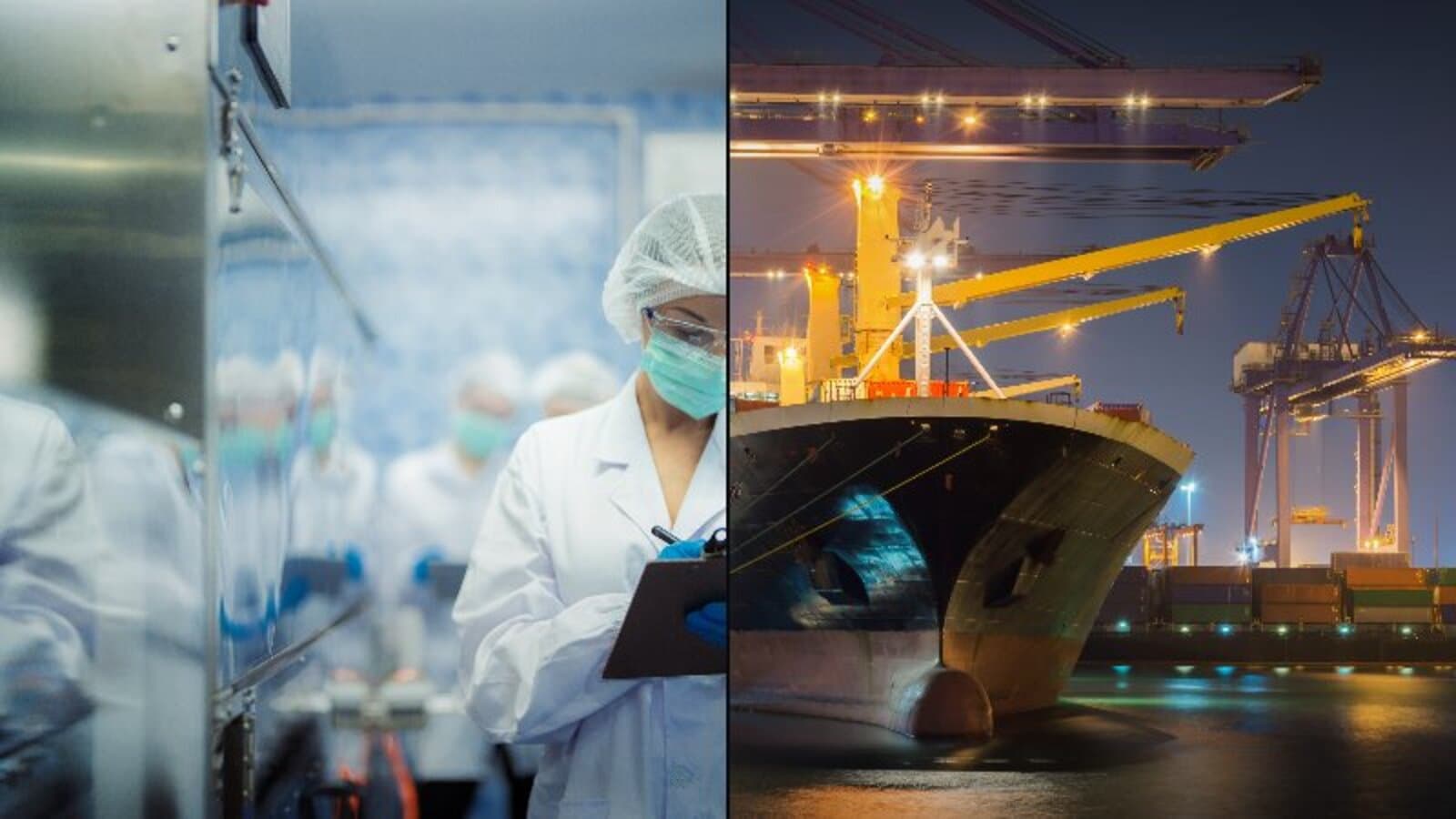
Military production tells the same story at industrial scale. US naval intelligence assessments put China's shipbuilding capacity at roughly 230 times that of the United States — Chinese shipyards can produce on the order of 23 million tons of shipping annually against well under 100,000 tons for American yards. China's navy has already passed 370 hulls to the US Navy's shrinking fleet of 287, making it the largest navy in the world by ship count, with projections putting China at nearly 475 vessels by 2035 against roughly 305 to 317 for the US. On next-generation airpower, China is simultaneously flight-testing two distinct sixth-generation fighter designs — the tailless, three-engine J-36 and the tailless, twin-engine J-50 — with multiple prototype iterations already flown and a stated ambition to field an operational sixth-generation aircraft before 2030. The US, by contrast, has no comparable sixth-generation prototype currently in the air. The US Navy retains real qualitative advantages in carriers, submarines, and combat experience, and China's timeline for an actual combat-ready sixth-generation fleet remains unconfirmed rather than guaranteed — but the gap in prototyping cadence alone is not a close contest right now.
Perhaps the most symbolically pointed data point is also the most recent. Omar Yaghi, who shared the 2025 Nobel Prize in Chemistry for his work on metal-organic frameworks, left nearly five decades in the United States this month to join Tsinghua University full-time, where he'll lead a new institute combining AI, chemistry, and materials science. China didn't just recruit one laureate; by most accounts it recruited the research team, international collaborators, and future discoveries likely to cluster around him for the rest of his career. That's the sharpest possible illustration of a broader brain-drain dynamic now underway — talent flowing toward wherever the funding, ambition, and institutional platform are largest, and increasingly, that's no longer a default assumption in America's favor.
None of this is an argument that the United States has lost the overall competition, or that American advantages in frontier AI research, financial markets, and alliance networks have evaporated. It's a narrower and more uncomfortable point: on the specific list of industries and technologies that determine long-run material and strategic power — energy inputs, batteries, EVs, biopharma innovation, naval production, and next-generation airpower — China isn't chasing the US anymore on most of them. It's setting the pace, and the US is increasingly the one being asked to catch up.
More from Opinion
The AI Trade's Circular Logic Meets China's Chip Breakthrough — And Wall Street Doesn't Like the Math
Nvidia's fresh $750 billion round of AI deals reignited fears of circular financing just as a Chinese state-backed firm revealed it is mass-producing homegrown DUV lithography machines and memory maker CXMT went public. Add Apple's own lobbying to use blacklisted Chinese DRAM chips, and the contradictions in the AI trade and US tech policy are showing all at once.

Trump's Iran Pause Looks Like TACO Again — And the 'Talks' He Claims Aren't the Talks Actually Happening
Trump halted strikes on Iran after roughly two weeks, framing it as progress toward talks with Tehran. Iran says it has no negotiations with the United States at present — the actual talks underway are a separate Iran-Oman bilateral channel on Hormuz shipping traffic. Add in a blunt Pentagon warning about depleted munitions, and this is starting to look like the same pattern critics labeled 'TACO' back in April.

Every US Radar Iran Destroys Is Also a Data Point China and Russia Get to Study
Iran's decentralized 'Mosaic Defense' doctrine was built to survive exactly this kind of war. Five months in, it's also generated something arguably more valuable than any single battle: a real-world dataset on how US Patriot and THAAD systems fail — and evidence China and Russia are already helping collect it.